
RHYME / INSIGHTS / ANNUAL REPORTS
How to Write an Annual Report That Doesn’t Suck
Simplify complex truths. Tell a good story. Keep things pretty.
The last thing you want a shareholder to say when they flip through your annual report is, “This sucks.”
Imagine having excellent growth, great cash flow, and a greener planet, but your report reads like an installation guide for a knock-off IKEA cabinet dropshipped from Guangdong?
An annual report should not be an exercise in corporate dullness. Bob from finance might be turned on by endless paragraphs and bullet points; it doesn’t mean you should foist that monotony on others.
Also, an annual report isn’t a trophy – a feat of corporate taxidermy where the year’s achievements, financial results, and disclosures are filed on a shelf to gather dust, or slapped on a coffee table to be thumbed through by bored visitors in your lobby.
It’s an opportunity to explain what kind of company you are.
Your mastery when opportunities present themselves. Your mettle when things get tough. Your motivation when markets are uncertain and your customers are feeling the pinch.
Your annual report is more than a collection of figures and stats. It’s a story, waiting to be told. A window through which your shareholders, the media, potential investors, and the general public get a glimpse of your company in action.
What makes an annual report worth reading?
There are at least three guiding principles to producing a good annual report.
1. Simplify complex truths
“Speak as you might to a young child or a golden retriever… Just relax. Stand up. Tell us in a clear voice. What is the nature of the problem?”
John Tuld, Margin Call
Most reports are prepared with one reader in mind: the smart graybeard who does math in his sleep. And while this might describe some of your shareholders, there are many types of people interested in what you have to report – and they have a low tolerance for thick paragraphs, difficult graphs, and endless jargon.
They might be smart, but that doesn’t mean you should make them work overtime to understand your report. They need something that’s easy on the brain and bile duct.
So, simplify complex truths.
You’ll be surprised at how helpful an infographic can be at explaining numbers. Or how a choice metaphor can communicate a complex idea.
During a pitch for a bank, we took a dense, jargon-heavy account of its divisional performance and restructured it into a clear, logical narrative. We cut out repetitive words. Consolidated sentences. Then we separated achievements from the initiatives that drove them, improved the flow, and gave readers a much better understanding of what actually happened.
There’s a time for technical complexity; there’s a season for simplicity. When your goal is to help readers understand a challenging year, be calm, clear, and direct.
Caveat: simplification doesn’t mean you must sacrifice accuracy. You can be rigorous, data-driven, factual, and reader-friendly at the same time.
2. Tell a good story
It doesn’t matter how big or small, famous or unknown, nice or notorious your company is: every year is a story worth sharing.
The thing is, many teams mistake numbers for the story. They say things like, “Let the numbers do the talking.” That’s like inviting people to a zoo and saying, “Check out the amazing buildings.”
Show us the parrots, the rhinos, the pythons!
Your main attraction isn’t the numbers, important as they are. It’s what’s behind the numbers – the people, the policies, and the decisions that mattered in the year that was.
Writing a story is not creating fiction. It’s not about sloganeering or finding a way to make unfavorable results disappear.
Story is about organizing the details into a clear journey from A to Z. Sometimes there’s drama, the spectacle of conquering new heights and overcoming lows.
Sometimes it’s a simple explanation of priorities, decisions, and results.
Your readers are human. Story is how we naturally communicate.
Sure, you can present a set of facts, replete with numbers and something about how you “remain committed to driving sustainable growth, enhancing stakeholder value, and leveraging operational efficiencies to deliver long-term success.”
But come on, everyone says this.
Better to take your readers on a little journey, show them the sights, the sounds, the fury.
We’re not talking decoration. We’re talking direction. A good story gives readers their bearings and helps them understand how you’ve weathered the year.
One caution: story is great but truth is king
Sometimes, when developing a story, you unearth a good metaphor for how the company has performed over the past year. For example, you choose “surviving the Amazon” as the metaphor to describe how your company has overcome sluggish growth, cleared a path to better business, and explored exciting new territories where others fear to tread.
Before you run with it, test the idea.
Does it make sense of the company’s strategic decisions? Does it accommodate both achievements and challenges? Can different divisions recognize their experiences within it?
Sometimes a concept is beautiful but wrong. If the information has to be bent to fit the metaphor, the metaphor needs to change.
3. Keep things pretty
Annual reports are almost always better when they’re nicely designed.
Yes, some companies literally just submit a text-only document and call it a day.
But what’s the fun in that?
A great report is a visually appealing document, cover to cover.
Strong typography establishes hierarchy. Illustrations punctuate ideas. Charts demonstrate patterns. Layouts help readers locate information and understand story flow.
Visual design can be the difference between stating facts and actually making a statement.
Furthermore, a poorly designed annual report can unintentionally obscure data, or draw attention to the wrong things.
A report might contain everything a shareholder needs to know and still be nearly impossible to navigate. We’ve seen reports that are just walls of text, punctuated by headlines and photos. We prefer to distinguish between sections with standalone visual breaks, huge photos with minimal text, or headlines that physically dominate, then use color, illustrations, and sometimes even breadcrumbs to signal where the reader is.
Good design lets readers find the information that matters to them, makes sections clear, and distinguishes major highlights from supporting detail.
When things are a disaster
Let’s face it, not everything you report will be good news. Sometimes, there’s a spectacular crash you simply cannot gloss over.
When it comes to difficult and sensitive business performance, you need not fudge the numbers or spin-doctor the truth. Not only is that potentially a serious legal and regulatory matter, but it’s just poor reporting.
Instead, lean on those with editorial savvy to help articulate difficult truths.
We call this responsible storytelling: presenting the relevant facts accurately, explaining their context, acknowledging challenges, and helping readers understand the decisions taken in response.
Must every setback become the headline? No. Must every material fact be disclosed? Absolutely.
By the way, it’s often the bold, pragmatic, and decisive leadership in the face of pain that is the real story. Of course, the real story might also be about poor decisions, unresolved problems, or the need for change.
Responsible storytelling creates space to be truthful and creatively articulate.
Handled honestly and within the applicable reporting requirements, difficult situations can become opportunities to explain the company’s response, decisions, and direction with greater clarity.
Why hire an external annual report agency?
The savvy investor relations person hires an external agency to help. Why? Because a good agency knows how to spot opportunities in your presentation and has the guts to tell you when something isn’t working.
Take, for example, editorial distance. An investor relations team is obviously close to the business; its familiarity with technical terminology and department priorities may affect how a story is told. An external agency can ask questions that insiders no longer think to ask: Is this clear to someone who doesn’t work here? Does this claim have evidence behind it? Does this section belong in the story? What is the most important thing the reader needs to understand?
A good agency will build a relationship with the investor relations team. The aim isn’t to replace the team or usurp its authority, but to enhance its work, elevate the annual report, and make it truly useful to readers.
Case in point: Universal Robina Corporation
Rhyme has worked with Universal Robina for a few years now, longer if you include our past lives. The challenge is consistent: how do we communicate the year’s story – the glorious upswings and challenging downturns – without sounding tone-deaf and drunk on self-love?
We begin by listening. We ask management what defined the year, what decisions mattered, and what readers need to understand. We study the company’s announcements, performance, and internal material, looking for recurring ideas, challenges, and distinctions. Then, working closely with the Investor Relations team, we identify the themes and metaphors that best capture the year’s story.
From that information, we develop three possible titles and accompanying rationales. Two generally remain within the company’s established brand language and territory. The third is what we call the wildcard option, a deliberately more adventurous interpretation.
The client usually shortlists two, discusses their merits, and votes on the strongest. Often, elements from the other proposals find their way into the preferred concept.
The final narrative must feel coherent even when it emerges from multiple competing ideas and perspectives.
Sometimes a client will like a particular idea that’s perhaps not as strong as it could be. We’ll make the case for what we believe is stronger. But we’re equally willing to change our minds when a client’s suggestion improves the work.
Good editorial judgment isn’t about defending every idea. It’s about knowing which ideas are worth defending and when to kill your darlings.
2023 – Upstream Evolution

The COVID-19 pandemic was over, but markets were still reeling. The company felt like it was fighting an upstream battle. It overcame a difficult year by evolving – introducing digital initiatives, streamlining operations, building new infrastructure to prepare for future production – to meet the pressures of the moment.
2024 – Navigating Transitions
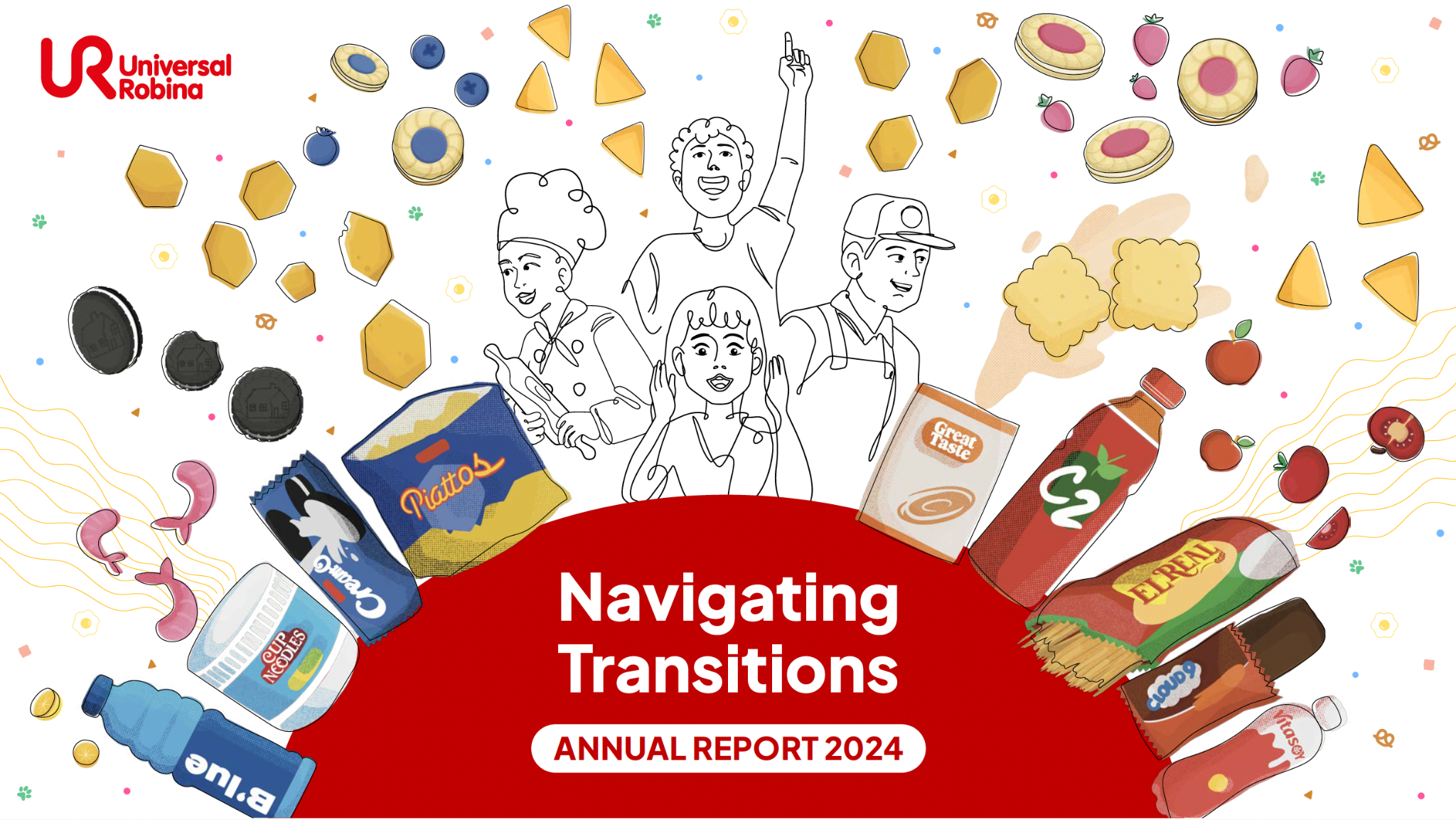
Fluctuating market conditions, unexpected challenges, and shifts in consumer demand were some of the challenges facing URC in 2024. The company introduced new products, a broader range of price points, and expanded globally to help navigate the transition from sluggish economy to sustainable growth.
2025 – Clarity and Courage

Global conflict had affected the prices of goods, pressured supply chains, and thrown business into uncertainty. Leadership needed to be clear on strategic direction and courageous when it came to making tough decisions.
Three different years, and three ways of telling the year’s story in ways that are compelling and based on events and decisions that actually happened.
The reader is the point
I remember standing outside the annual shareholders’ meeting of a large energy company (we were on standby to direct their post-meeting pictorial). I was thinking, “Do these guys even read the annual report?” “Have they got the energy to read every jot and tittle?” “What does jot and tittle actually mean?”
Then it dawned on me. Some readers will examine every disclosure. Others will want a clear explanation of performance and direction. Some will have followed the company for decades; others will be encountering it for the first time. A great report should accommodate different levels of familiarity and interest.
So, if you’re about to embark on writing an annual report, or finding a team to help you bring your next report to life, just remember to ask yourself:
- What actually defined our year, beyond the headline financial results?
- What do readers need to understand about the decisions we made?
- What should someone remember after closing the report?
Simplify complex truths, tell a good story, and keep things pretty.
That way, your annual report won’t suck. It’ll sing.